

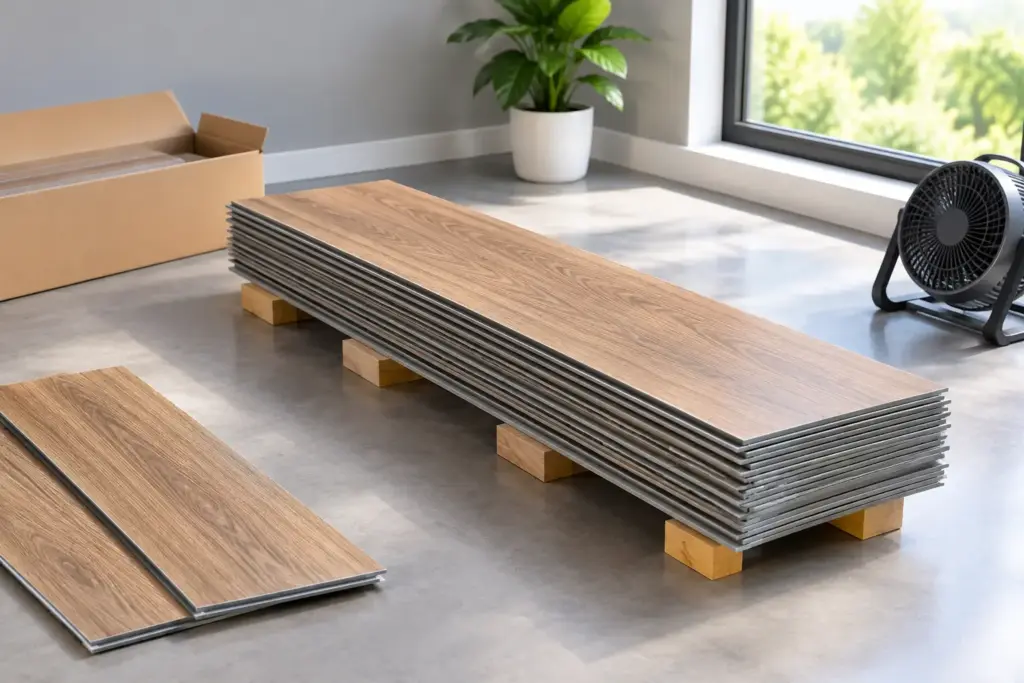
A click-lock floor can look precise on installation day and still develop avoidable issues if it is brought into an unconditioned space too late. Knowing how to acclimate SPC planks gives the material, the room, and the installation team a controlled starting point. It is a straightforward step, but one that protects joint performance, layout accuracy, and the finished appearance of the floor.
SPC flooring is valued for its dimensional stability. Its rigid stone plastic composite core is less reactive than many traditional flooring materials, particularly in rooms with changing humidity. That does not mean cartons should move directly from a delivery truck to the installation area. Temperature differences, uneven site conditions, and poor storage practices can still affect the planks and the click-lock system during installation.
Why SPC Plank Acclimation Still Matters
Acclimation is not only about waiting a set number of hours. It is about allowing flooring cartons to reach the normal temperature of the occupied space before installation begins. When cartons have been stored in a warehouse, delivery vehicle, garage, or unfinished building, the planks may be significantly warmer or cooler than the room where they will be installed.
Installing cold planks in a heated room can make them less flexible at the click joints. Installing material that has been exposed to excessive heat can create the opposite problem, making handling less controlled and increasing the chance of forcing a connection. In either case, installers may misread how the floor will behave once the indoor environment stabilizes.
For contractors and project teams, proper acclimation also creates a more reliable handoff between trades. Flooring should not be used to compensate for a room that is still wet, dusty, unheated, or subject to major temperature swings. The floor performs best when the project is ready for it.
How to Acclimate SPC Planks Correctly
Begin by reviewing the flooring product instructions for the specific collection being installed. Manufacturer requirements always take priority, including stated acclimation time, approved indoor conditions, subfloor standards, and any guidance for sun-exposed areas or radiant heat systems. Many SPC products require a period of conditioning in the installation environment, commonly at least 24 to 48 hours, but the correct duration depends on the product and jobsite conditions.
Bring unopened cartons into the finished installation area rather than storing them in a hallway, garage, loading zone, or exterior-covered space. The room should be enclosed and operating under the same temperature conditions expected after occupancy. If heating or air conditioning will be used in normal service, it should already be running before the flooring arrives.
Keep the cartons flat on a clean, dry, level surface. Do not stand cartons on their edges, lean them against walls, or place them over uneven debris. This can put stress on rigid planks and may affect the straightness of the boards before installation begins. Avoid stacking cartons too high, especially where lower boxes can be compressed or where a stack may become unstable.
Do not place cartons directly against exterior walls, near heating vents, beside fireplaces, in direct sunlight, or in front of temporary construction heaters. The purpose is to condition the material evenly. A hot or cold pocket within the room defeats that purpose and can create inconsistent plank temperatures across the installation.
There is usually no need to open every carton during acclimation unless the product instructions call for it. Keeping cartons sealed protects the planks from construction dust, accidental damage, and moisture exposure. Open cartons only when the installer is ready to inspect, sort, and install the material.
Condition the Room, Not Just the Flooring
SPC is highly water-resistant, but acclimation does not correct a damp subfloor or an uncontrolled indoor environment. Concrete must be properly cured, dry according to the flooring system requirements, and tested where required. Wood subfloors must be sound, clean, dry, and securely fastened. Any unevenness beyond the installation tolerance should be corrected before planks are opened.
This distinction matters. A plank can reach room temperature within its carton, yet the installation can still fail if the slab has excess moisture, if the subfloor is not flat, or if the building HVAC system is not operating. Acclimation is one part of a disciplined installation process, not a replacement for site preparation.
For renovation work, allow the room to recover after activities that change its conditions. Fresh plaster, paint, tile work, and wet trades can introduce moisture and make the space unsuitable for flooring. Schedule SPC installation after those materials have dried and the area has been cleaned.
Check the Planks Before Installation
Once the acclimation period is complete, inspect the material under good lighting before installation. Confirm that the product name, color, style, and quantity match the approved order. Check cartons for transit damage and review several planks from different boxes for visible defects, edge damage, or unusual color variation.
Mix planks from multiple cartons as installation progresses. This is particularly valuable for wood-look and stone-look visuals, where natural variation is part of the design. Blending cartons helps distribute tonal and pattern differences across the room rather than concentrating similar boards in one area.
Do not install visibly damaged planks or boards with compromised click-lock profiles. Once a plank is cut, clicked into place, or installed, it is generally considered accepted. Identifying concerns before installation protects both the project schedule and the finished floor.
Protect the Click-Lock System
Precision click-lock joints are designed for efficient floating-floor installation, but they should never be forced. If a joint resists connection, stop and check for debris, a damaged edge, an incorrect angle, or a subfloor irregularity. Forcing a plank can damage the locking profile and create a weak point that may later separate or lift.
Use the installation method specified for the product’s locking system. Some systems are designed to angle in on the long side before securing the short end, while others have a drop-lock function. The right technique produces clean, tight joints without excessive impact. The wrong technique can damage even premium flooring before the room is complete.
Maintain the required expansion space around perimeter walls, fixed cabinetry, pipes, columns, and other vertical obstructions. SPC is stable, but floating floors still need space to respond to normal environmental movement. Do not trap the floor beneath heavy fixed fixtures unless the product instructions expressly allow it.
Acclimation Mistakes That Create Preventable Problems
The most common mistake is delivering flooring before the building is ready and leaving it in uncontrolled conditions. A garage may be convenient for staging, but it is rarely an appropriate acclimation space. The same applies to a jobsite with open windows, active concrete work, temporary heating, or no reliable climate control.
Another mistake is assuming that all SPC floors have identical requirements. Core construction, thickness, backing, locking profile, and warranty conditions can vary by product. A reliable installation team checks the instructions for the exact flooring selected rather than applying a generic rule from another job.
Rushing the process to meet a handover date can also increase waste. Cold, overheated, or poorly handled planks are harder to install accurately. Lost time from damaged locking edges, rejected boards, or avoidable callbacks can cost more than allowing the site to stabilize first.
Finally, avoid using acclimation as a reason to ignore sunlight and heat planning. Large windows, floor-to-ceiling glazing, dark flooring colors, and rooms with sustained direct sun can create higher surface temperatures after installation. Window treatments, appropriate expansion allowances, and product-specific guidance should be considered during design and installation planning.
When Jobsite Conditions Need Extra Attention
Commercial projects, multifamily developments, and staged renovation work often need a more formal material-control process. Record delivery dates, room conditions, carton locations, and the start of acclimation. For larger projects, this documentation helps project managers coordinate flooring with HVAC commissioning, moisture testing, and final cleaning.
In colder regions or during winter deliveries, allow extra attention to material handling. Cartons that arrive from a cold vehicle should not be opened immediately in a warm room. Move them carefully into the conditioned space, keep them flat, and allow the full manufacturer-recommended period before installation.
The same care applies to warm-weather storage. Excess heat can affect carton packaging and make planks uncomfortable to handle. Keep flooring out of direct sun and away from enclosed spaces that build heat, such as metal containers or vehicles left outdoors.
PLUZ SPC flooring is engineered for dependable everyday performance, but performance starts with correct handling before the first plank is clicked into place. When the room is stable, the subfloor is ready, and the cartons have been properly conditioned, installers can work with greater accuracy and owners can move forward with confidence in the finished space.