

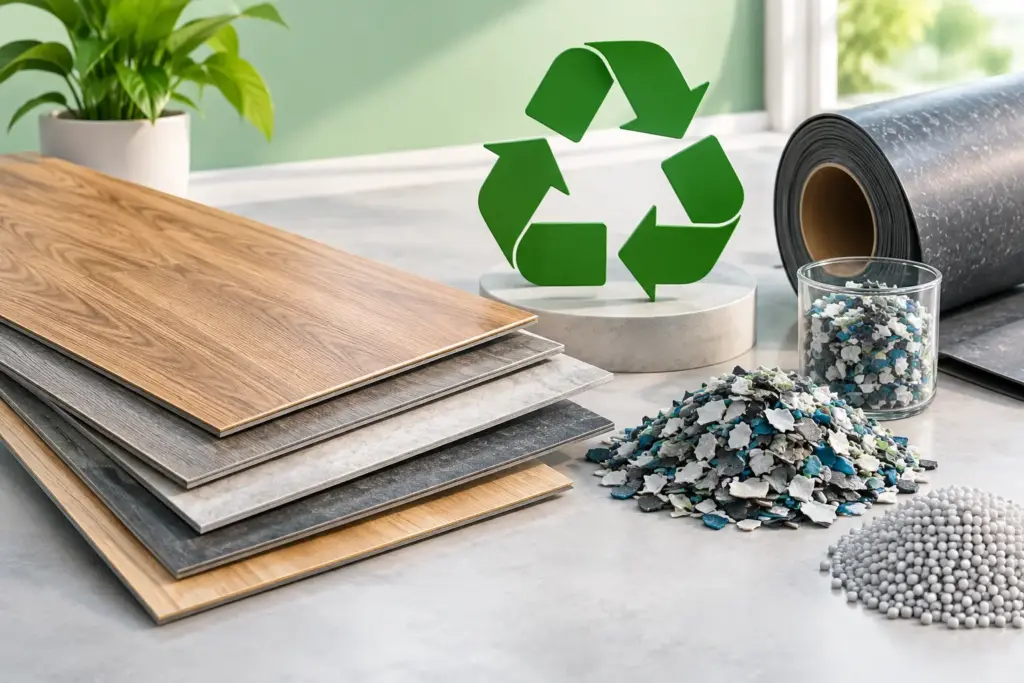
A flooring specification can look sustainable on paper and still create a disposal problem years later. For contractors, developers, distributors, and homeowners, recyclable vinyl flooring materials deserve a closer look: recyclability depends on the product’s composition, how it is installed, and whether a realistic recovery route exists after removal.
Vinyl flooring remains a practical choice for demanding interiors because it can be water-resistant, durable, easy to clean, and available in convincing wood and stone visuals. The responsible purchasing question is not whether every vinyl floor can be recycled in every market. It is whether the selected material has a clear, consistent composition and can enter an appropriate recovery stream when its service life ends.
What Makes Vinyl Flooring Recyclable?
Vinyl flooring is typically built around polyvinyl chloride, commonly called PVC, combined with stabilizers, pigments, fillers, and performance layers. PVC itself can be recycled, particularly when it is clean, sorted, and returned through a controlled process. The challenge is that flooring is rarely made from one material alone.
A product becomes more practical to recycle when its formulation is known, its layers are compatible, and it can be separated from adhesives, underlayment, and jobsite debris. Manufacturing offcuts are usually the easiest material to recover because they are clean, traceable, and consistent. Used flooring from renovation or demolition projects requires more planning.
This distinction matters in commercial procurement. A claim that a floor is “recyclable” should describe the material’s capability under suitable collection and processing conditions, not promise that any removed plank can go into a curbside recycling bin. Most municipal programs are not designed for flooring products.
Why Material Consistency Matters
For recovery partners, mixed materials are difficult to process. A floor containing unknown recycled inputs, inconsistent additives, heavy adhesive residue, or multiple bonded layers may be technically recyclable but commercially impractical to recover. Consistency improves sorting, processing, and confidence in the recycled output.
This is one reason virgin-material SPC and luxury vinyl click flooring can be relevant to a responsible specification. Virgin raw materials provide a controlled starting formulation and consistent batch quality. When the product is also designed with recyclable material potential, manufacturers and recovery partners have a clearer understanding of what they are handling.
At PLUZ SPC, 100% virgin recyclable materials are paired with precision production controls. For buyers, that approach is not only about an environmental statement. It supports dependable color, dimensional stability, and performance across repeat orders, which is especially valuable for phased commercial projects and distributor programs.
SPC Flooring and Recyclability
Stone plastic composite flooring is a rigid vinyl-based flooring category, generally made with PVC resin and mineral content such as calcium carbonate. Its rigid core helps deliver stability and resistance to everyday moisture, while its click-lock construction can reduce dependence on full-spread adhesive.
That installation detail has real end-of-life value. A floating click floor is often easier to remove in larger, cleaner pieces than glued-down material. Cleaner removal does not guarantee recycling, but it can make sorting and collection more feasible. It also reduces the amount of adhesive-contaminated waste generated during renovation.
SPC is not automatically the best option for every project. Its mineral-filled composition, wear layer, backing, and attached pad all affect how a recycler may handle it. Buyers should avoid broad assumptions and ask for product-specific information. The more transparent the manufacturer is about construction and raw materials, the easier it is to assess the product responsibly.
Click-Lock Construction Supports Better Removal
Click systems such as Välinge 2G and 5G are primarily selected for installation speed, secure plank connection, and a clean finished appearance. They can also support a less destructive removal process compared with permanently bonded flooring.
For retail refreshes, hospitality renovations, and tenant improvement projects, this can be useful. If installers can lift planks without excessive breakage or adhesive contamination, the material has a better chance of being evaluated for reuse, recycling, or controlled disposal. Site conditions still matter. Water damage, heavy contamination, and damaged planks can limit recovery options.
How to Specify Recyclable Vinyl Flooring Materials
The best time to address recovery is before the purchase order is issued. A project team should consider the floor’s full service life, including installation method, expected replacement cycle, maintenance requirements, and removal plan.
Start by asking the supplier for a clear product construction description. Confirm whether the flooring uses virgin or recycled content, how the core and backing are made, and whether the manufacturer identifies the material as recyclable. Request documentation that matches the exact product and collection, rather than relying on a general statement about vinyl flooring.
Next, choose an installation method that aligns with the project’s needs. Glue-down flooring may be necessary for certain high-traffic environments or specific subfloor conditions. Where a floating floor is suitable, click-lock planks can simplify installation and future removal. This is a trade-off, not a universal rule: performance requirements should always guide the decision.
Finally, plan for removal before the floor is installed. Large commercial projects may be able to coordinate with a specialized recycling or waste-management partner. Smaller residential projects may have fewer local options, but homeowners can still keep flooring debris separated from general construction waste and ask local facilities about accepted PVC-based materials.
Questions Buyers Should Ask Suppliers
A responsible supplier should be ready to discuss more than surface color and plank size. Before specifying a product, buyers should ask:
- What are the primary materials in the core, wear layer, backing, and attached pad?
- Is the product made with a controlled, consistent formulation across production batches?
- Is it identified as recyclable, and under what conditions?
- Can the floor be installed as a floating click system without full-spread adhesive?
- Are there recommendations for separating and handling offcuts or removed planks?
- What performance standards support a long service life before replacement is necessary?
These questions also protect project quality. A floor that lasts longer, resists scratches, handles moisture, and maintains its appearance reduces the frequency of replacement. Durability is not a substitute for recycling, but it is a meaningful part of reducing material consumption over time.
Design Life Is Part of Responsible Flooring
A recyclable product that is replaced prematurely offers limited value. Flooring should be selected for the actual demands of the space: rolling loads in retail, spills in family homes, heavy foot traffic in common areas, or acoustic expectations in multi-unit projects.
For this reason, responsible vinyl flooring selection combines material transparency with engineering performance. Water resistance, scratch resistance, sound reduction, fire resistance, and termite resistance can help a floor remain in service longer when they are matched to the application. The visual choice matters too. A timeless oak, balanced concrete tone, or restrained neutral can outlast a short-lived design trend and reduce the pressure for cosmetic renovation.
For distributors and OEM buyers, consistency is equally important. Reliable production makes it easier to replenish an established collection without avoidable variation in color, texture, or fit. That protects the original installation and reduces unnecessary replacement of unaffected areas.
The Practical Standard for Better Decisions
Recyclability should be treated as one part of a broader flooring decision, alongside safety, durability, installation, maintenance, design, and supply reliability. Be cautious of absolute claims. Ask whether recovery is feasible in the project’s location, whether the material can be removed cleanly, and whether the product’s construction is documented clearly enough for a recycling partner to evaluate it.
The strongest choice is often a well-made vinyl click floor with a known formulation, long service life, precise locking performance, and a realistic plan for handling waste. Specify for the space you have, install with future removal in mind, and keep material information with the project records. Those practical steps give recyclable vinyl flooring materials their best chance to deliver value long after installation day.