

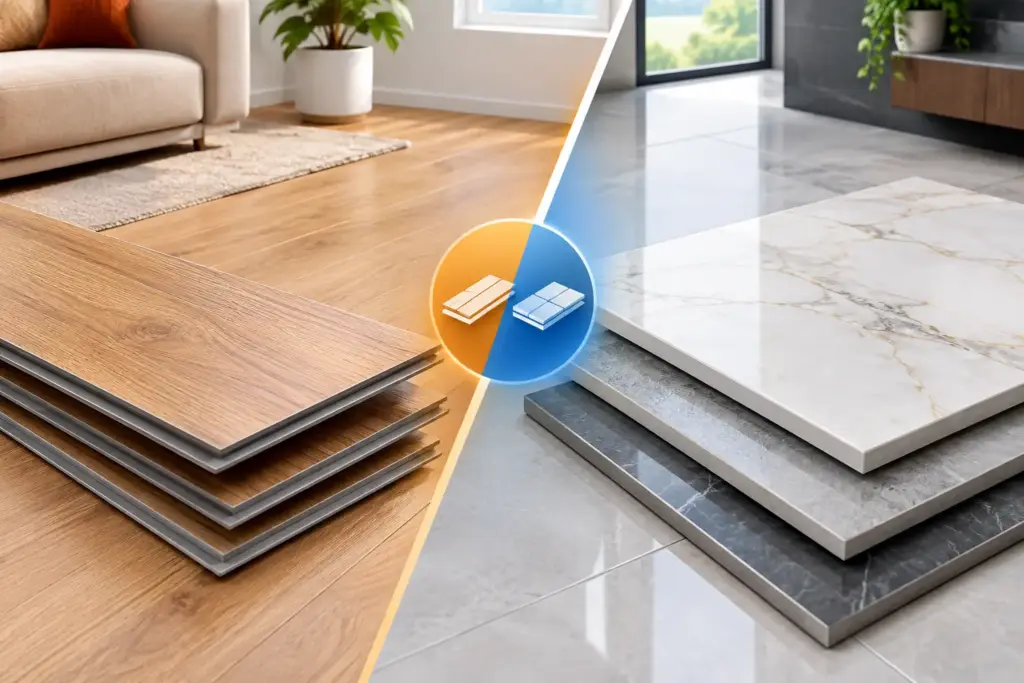
A flooring decision can change the pace, cost, and risk profile of an entire project. When comparing SPC versus porcelain tiles, the better choice is rarely the one with the highest specification on paper. It is the material that fits the space, subfloor, installation schedule, maintenance plan, and expectations of the people who will use it every day.
Porcelain has long been trusted for hard-working wet areas and high-end finishes. SPC flooring has become a serious alternative for renovations, multifamily interiors, hospitality rooms, retail spaces, and homes where fast installation and underfoot comfort matter. Both are water-resistant flooring options, but they deliver very different project outcomes.
SPC Versus Porcelain Tiles at a Glance
SPC, or stone plastic composite flooring, is a rigid-core click flooring made with a mineral-based composite core, a decorative layer, and a protective wear layer. Quality SPC products are engineered for dimensional stability, moisture resistance, impact resistance, and efficient floating-floor installation.
Porcelain is a fired ceramic tile with a dense body and low water absorption. It is installed with adhesive and grout over a prepared substrate. Its strength, heat resistance, and visual range make it a standard choice for bathrooms, kitchens, balconies, lobbies, and exterior-rated applications when the correct tile is specified.
The essential difference is installation method and material behavior. SPC is a floating floor that is comparatively warm, resilient, and quick to install. Porcelain is a bonded hard surface that delivers exceptional rigidity and long-term wear performance but requires more labor, curing time, and substrate preparation.
Water Resistance Is Not the Whole Story
Both materials perform well around everyday spills. An SPC plank has a water-resistant core and a tightly joined click system, making it suitable for kitchens, entryways, laundry areas, and many residential bathroom applications. It does not swell like traditional wood-based flooring when surface water is addressed promptly.
Porcelain offers outstanding water resistance and is generally the safer choice for continuously wet environments, shower walls, wet rooms, and areas where water may sit for extended periods. However, a tiled floor is a system, not just a tile. Grout joints, movement joints, waterproofing membranes, drainage, and installation quality all determine whether the finished assembly performs as intended.
For a standard powder room or kitchen renovation, SPC may deliver the practical water protection a client needs with less disruption. For a curbless shower, pool surround, commercial washroom, or exterior terrace, properly specified porcelain remains the more appropriate material.
Installation Speed and Site Conditions
Installation is often where SPC changes the project calculation. Click-lock SPC can be installed over many existing hard surfaces, provided the base is clean, dry, stable, and sufficiently flat. This can reduce demolition, limit noise and dust, and shorten downtime in occupied homes, hotel rooms, retail units, and phased renovation projects.
A well-engineered click system also supports consistent plank engagement. PLUZ SPC uses Välinge 2G and 5G locking technology to support efficient installation and reliable joint performance when installation requirements are followed.
Porcelain installation demands a more involved process. Installers must evaluate substrate flatness, moisture conditions, crack isolation needs, adhesive selection, tile layout, grout selection, and curing time. Large-format porcelain can look striking, but it raises the stakes: minor unevenness in the substrate can create lippage, and poor adhesive coverage can lead to cracking or hollow spots.
This does not make porcelain a poor choice. It makes porcelain a choice that should be planned early and installed by qualified tile professionals. Where project schedules are tight or access is restricted, SPC’s dry, floating installation can offer a major advantage.
Subfloor preparation still matters for SPC
SPC is forgiving in some ways, but it is not a solution for an unstable floor. A rigid core can telegraph sharp imperfections, and excessive unevenness can place stress on the click joints. Moisture testing, leveling, expansion clearances, and the manufacturer’s installation guidance remain essential.
The practical advantage is that preparing a floor for SPC is often faster and less material-intensive than preparing it for tile. For renovation teams managing occupied spaces, that difference can protect both schedule and budget.
Comfort, Acoustics, and Everyday Use
Porcelain feels solid and cool underfoot. In warm climates, that can be desirable. In bedrooms, living spaces, and air-conditioned commercial interiors, however, some occupants find tile hard, cold, and tiring to stand on for long periods.
SPC has a more comfortable feel because its layered construction provides slight resilience compared with ceramic. Many SPC products also include an attached acoustic backing, which can help reduce footfall noise. The result is especially valuable in apartments, upper-floor residences, hotel rooms, offices, and spaces with children or pets.
Neither material should be oversold. SPC is still a hard-surface floor, not carpet or cork. Its acoustic performance depends on the complete floor assembly, including the existing slab, underlayment rules, and building requirements. Porcelain can also perform well acoustically when an appropriate sound-control system is built beneath it, but that adds cost and installation complexity.
Durability: Scratches, Impacts, and Heavy Loads
Porcelain is exceptionally hard and highly resistant to scratching, staining, and UV exposure. It is often the better option for sun-exposed areas, commercial entrances, and locations with abrasive dirt or heavy rolling loads. A properly installed porcelain floor can last for decades.
SPC is designed for daily wear, with a protective wear layer that resists scratches and stains from normal residential and light-to-moderate commercial use. It is also more forgiving when something is dropped. A glass may survive a fall on SPC that would likely break on tile, while a heavy sharp object can chip porcelain.
The trade-off is that SPC can dent under concentrated pressure, such as narrow furniture feet, poorly protected appliance legs, or high point loads. Furniture pads and appropriate load distribution are sensible precautions. For a busy commercial setting, buyers should assess traffic patterns, rolling equipment, entrance matting, and the specific wear-layer specification rather than choosing by appearance alone.
Design Flexibility and Visual Continuity
Porcelain offers a wide range of stone, concrete, terrazzo, and wood looks, including very large formats with minimal grout lines. It can create a crisp, architectural surface that suits luxury bathrooms, restaurants, and contemporary public spaces.
SPC offers design advantages of its own. Wood-look planks create visual continuity between living areas, bedrooms, kitchens, and hallways without the maintenance concerns associated with natural timber. Collections ranging from Nordic light oak tones to deeper rustic and urban finishes can help project teams match flooring to cabinetry, wall colors, and furniture with consistency across multiple units.
For multifamily, hospitality, and retail rollouts, batch consistency matters as much as appearance. A dependable manufacturing partner can help teams maintain a coordinated look through phased orders, mock-ups, and replacement stock planning.
Cost Should Be Measured Beyond Material Price
Porcelain and SPC prices vary widely, so a direct per-square-foot comparison can be misleading. A basic porcelain tile may cost less than premium SPC, while designer porcelain and large-format installation can significantly raise the total project cost.
Labor, demolition, leveling, adhesive, grout, waterproofing, curing time, breakage allowance, and business interruption all affect the installed cost of porcelain. SPC may cost more than entry-level tile at the material stage, but its faster installation and lower demolition requirements can make the overall project more economical.
Maintenance also differs. SPC generally needs routine sweeping and damp mopping with suitable cleaning products. Porcelain is similarly easy to clean, but grout may require more attention over time, particularly in light colors or high-use food-service and bathroom areas. Using the right grout can reduce maintenance, but it should be specified at the start.
When Porcelain Is the Better Choice
Choose porcelain when the space is continuously wet, exposed to intense heat or direct sun, subject to heavy rolling loads, or intended for an exterior-rated application. It is also the stronger option when a client wants a permanent mineral surface and accepts the higher installation commitment.
When SPC Is the Better Choice
Choose SPC when a project needs fast installation, reduced demolition, water-resistant performance, quieter and warmer underfoot comfort, and a refined wood-look finish. It is particularly practical for occupied renovations, residential interiors, apartments, hotel rooms, offices, and commercial spaces where downtime has a real cost.
The best flooring specification starts with a site review, not a sample board. Confirm the moisture condition, floor flatness, anticipated traffic, cleaning methods, heat exposure, and installation sequence before selecting either material. That early discipline helps ensure the finished floor looks right on opening day and continues performing well long after the project is handed over.