

A flooring sample can look convincing under showroom lighting and still disappoint once it reaches a busy lobby, rental unit, or family kitchen. Luxury vinyl earns its place when appearance is matched by the right core construction, locking system, surface protection, and manufacturing consistency. For buyers managing real timelines and real foot traffic, those details determine whether a floor stays attractive or becomes an early replacement cost.
What Luxury Vinyl Actually Means
Luxury vinyl is a category of resilient flooring made to reproduce the visual depth, texture, and plank or tile formats of natural materials. Luxury vinyl plank, often called LVP, is designed around wood visuals. Luxury vinyl tile, or LVT, generally takes inspiration from stone, concrete, ceramic, and other tile finishes.
The word “luxury” should not be treated as a performance guarantee. Products within this category vary significantly in thickness, wear layer, core composition, locking precision, backing, and dimensional stability. A well-specified floor can offer a refined finish with practical maintenance. A poorly specified one may show gaps, movement, surface wear, or inconsistent color between deliveries.
For commercial and residential buyers alike, the better question is not simply whether to choose vinyl. It is which construction is suited to the space, how reliably it can be supplied, and what installation conditions it requires.
Why SPC Has Changed Luxury Vinyl Flooring
Stone plastic composite, known as SPC, is a rigid-core form of luxury vinyl flooring. Its core combines mineral content with stabilizing polymers to create a dense, dimensionally stable plank. Compared with softer flexible vinyl products, SPC is better positioned for interiors where a firm feel, resistance to indentation, and stable click installation matter.
This construction is especially useful for renovation work. Rigid SPC planks can often handle minor subfloor imperfections better than thinner flexible materials, although they do not remove the need for proper preparation. High spots, loose substrate, moisture issues, and major unevenness must still be corrected before installation.
SPC also provides a practical balance for projects exposed to daily spills, humidity, and frequent cleaning. Its waterproof core makes it suitable for many kitchens, living spaces, retail environments, offices, and hospitality interiors. Water resistance, however, should not be confused with a solution for a failing subfloor or standing water beneath the floor. The installation system, perimeter detailing, and condition of the building remain important.
The Construction Behind a Better Plank
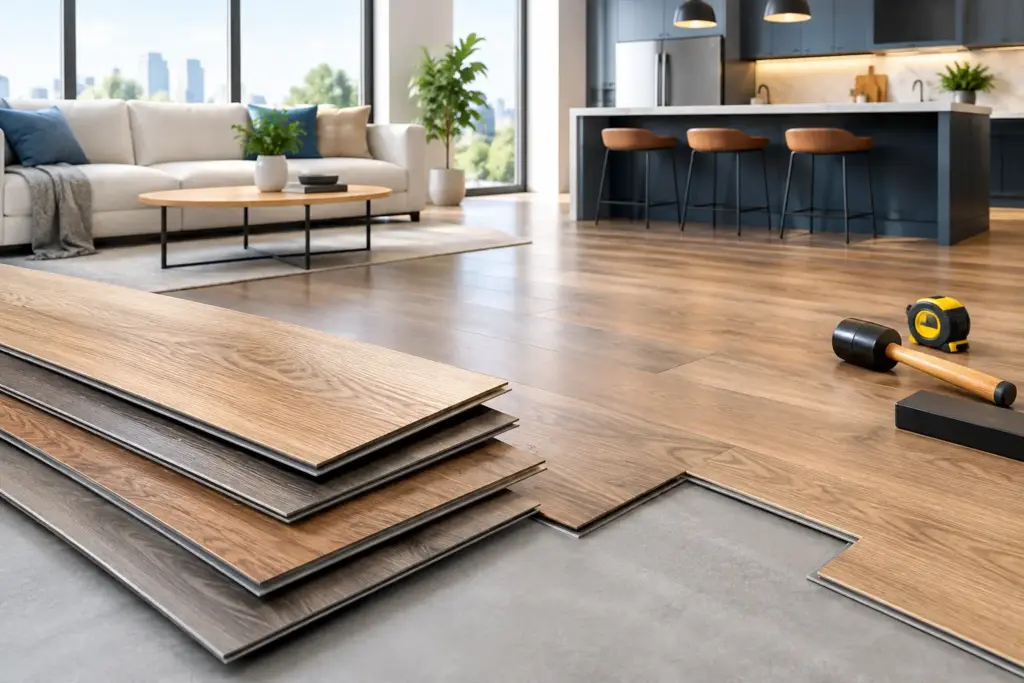
A quality SPC plank is built in layers, each with a job to do. The wear layer helps protect the decorative surface from abrasion and everyday scuffing. The printed film establishes the wood or stone visual. The rigid core delivers stability, while an attached underlayment can improve underfoot comfort and help reduce transmitted room noise.
The locking profile deserves equal attention. Precision click systems such as Välinge 2G and 5G are engineered to connect planks securely and support efficient installation. For contractors, a dependable locking system can reduce fitting time and limit avoidable breakage. For property owners, it supports a cleaner finished appearance with well-aligned joints.
Material inputs affect consistency as well. Flooring made with 100% virgin materials can provide more controlled performance than products that rely heavily on uncontrolled recycled content. Responsible manufacturing is not only about the material claim. It is also about repeatable formulation, quality checks, and accountable production from batch to batch.
Performance Should Match the Room
Luxury vinyl flooring is often chosen because it combines design flexibility with practical resilience. It is generally easier to maintain than many natural wood finishes, more comfortable underfoot than ceramic tile, and faster to install than some traditional flooring systems. Those advantages are meaningful, but they should be evaluated against the demands of the project.
In a home, priorities may include water resistance, quietness, pet-friendly durability, and a color that works with changing furnishings. In a retail store or office, cleaning frequency, rolling loads, entryway traffic, and the ability to replace damaged planks may carry more weight. Hotels and multifamily projects need a consistent visual standard across multiple rooms, dependable supply planning, and a surface that performs under housekeeping routines.
A thicker plank is not automatically better, and the highest wear-layer specification is not always necessary. A low-traffic bedroom has different needs from a restaurant entrance. The goal is to avoid both under-specifying a demanding area and paying for features that offer little practical return.
Questions to Ask Before Selecting a Collection
Start with the setting: residential, retail, workplace, hospitality, or mixed-use. Then consider the likely traffic pattern, exposure to moisture, furniture loads, and the condition of the subfloor. Design should follow these functional decisions, not replace them.
It is also wise to ask how samples relate to the final delivery. A manufacturer with disciplined batch control can help project teams maintain a consistent tone and grain pattern across phases. This matters when flooring is installed over a large area, ordered in stages, or extended during a later renovation.
For trade buyers and OEM partners, factory capability is part of product performance. Production lead times, packaging standards, export readiness, technical documentation, and communication during issue resolution all affect project outcomes. A floor can meet a written specification and still create problems if supply support is unreliable.
Design Without the Maintenance Burden
The strongest luxury vinyl collections do more than imitate a species name or a popular stain. They consider plank proportions, embossing, tonal movement, and the way a floor works with light throughout the day. A pale oak visual can make compact interiors feel more open. Warm rustic tones can bring comfort to hospitality and residential settings. Cooler concrete or gray oak looks may suit contemporary offices and urban retail concepts.
Design trends should be used with restraint. Extremely uniform patterns can feel artificial in large installations, while excessive variation can make a floor look visually busy. A balanced collection offers enough movement to appear natural without making layout control difficult for installers.
PLUZ SPC develops its flooring collections around distinct design directions, including Nordic, Rustic, Vintage, Minimalist, Contemporary, and Urban styles. This approach gives designers and project teams a clearer starting point than choosing from color names alone. The right collection should support the broader interior scheme while delivering the technical performance required beneath it.
Installation Is Where Specifications Become Reality
Click flooring is often described as easy to install, and compared with many glued-down systems, it can be. But “easy” does not mean careless. The subfloor must be clean, dry, level within the product requirements, and structurally sound. Flooring should be inspected before installation, and installers should follow the stated expansion-gap, layout, and transition details.
Temperature and humidity conditions also matter. Even stable rigid-core flooring responds to its environment. Installation in an uncontrolled space, direct sun exposure without appropriate consideration, or failure to provide expansion space can lead to preventable movement issues.
For commercial jobs, establish responsibility early. Confirm who checks the subfloor, who approves mockups, how damaged material is handled, and whether extra inventory will be retained for future repairs. Small decisions at this stage protect the finish long after the installation crew has left.
Maintenance That Protects the Finish
Luxury vinyl flooring does not require sanding, sealing, or specialized treatment for routine care. Regular dry cleaning removes grit that can dull the surface over time. Damp mopping with a manufacturer-approved cleaner handles everyday marks without leaving residue.
Avoid abrasive pads, steam cleaning unless specifically approved, and harsh chemicals that can affect the finish. Entrance mats are valuable in commercial spaces because they capture grit before it travels across the floor. Felt protection under furniture and suitable pads under movable equipment also help preserve the surface.
A water-resistant floor still benefits from prompt spill cleanup. That simple habit protects edges, reduces slip risks, and keeps the space looking professionally maintained.
Choose a Supply Partner, Not Just a Sample
Flooring decisions are often made around a small piece of material. Project success depends on much more: precise manufacturing, consistent batches, dependable delivery, clear technical guidance, and support when schedules change. For contractors, distributors, and developers, those factors can be as valuable as the product specification itself.
A well-chosen luxury vinyl floor should make the finished space look considered while making daily use easier. Select the construction for the environment, verify the installation plan before materials arrive, and work with a supplier prepared to stand behind every production run. That is how a floor becomes a reliable part of the project rather than a risk hidden beneath the furniture.