

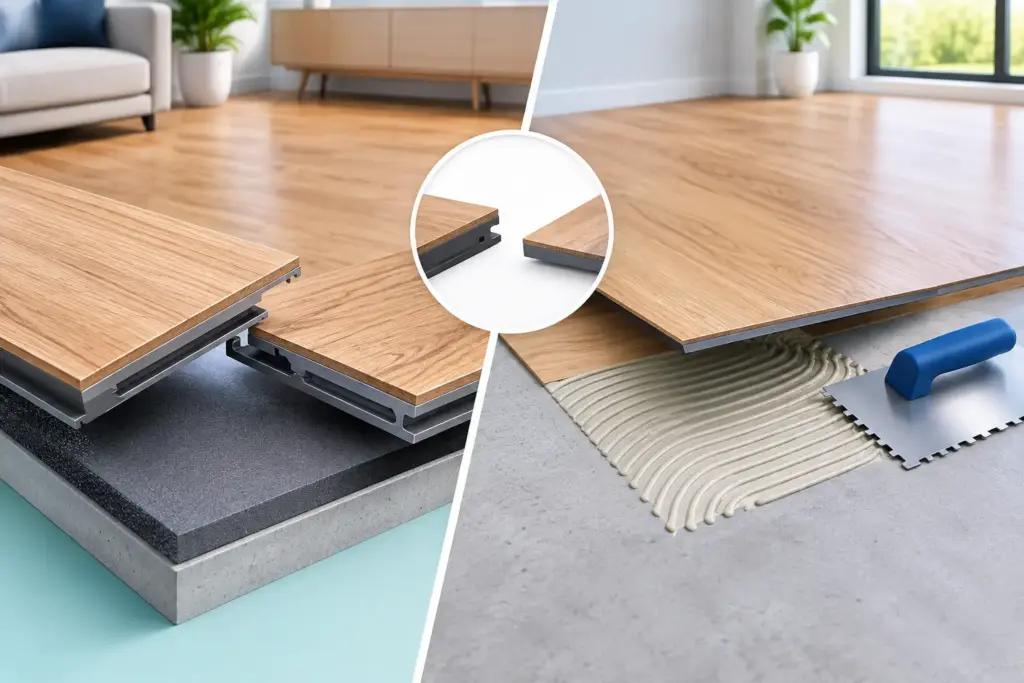
A flooring schedule can look complete on paper and still create problems on site. The decision between 5G click versus adhesive flooring affects installation sequencing, subfloor preparation, downtime, replacement work, and the finished floor’s behavior under daily traffic. For contractors, designers, and buyers, the right choice is less about a universal winner and more about matching the installation method to the project conditions.
What 5G Click Flooring Means
5G is a mechanical click-lock system used on the short ends of flooring planks. As a plank is lowered into place, the end joint locks automatically, helping create a secure connection without applying adhesive between the planks. It is commonly paired with an angle-click long-side profile in SPC and luxury vinyl click flooring.
The practical advantage is speed. Installers can assemble a floating floor efficiently with a clean, consistent joint pattern and no adhesive cure time. This can be especially valuable in occupied renovations, retail refreshes, residential projects, and multi-unit work where access windows are limited.
A 5G floor is still only as dependable as the plank, locking profile, and subfloor beneath it. Precision-manufactured profiles matter because inconsistent dimensions can lead to difficult engagement, visible gaps, or joint stress. A quality click system should engage firmly while allowing installers to maintain a steady installation rhythm.
How Adhesive Flooring Works
Adhesive flooring, often called glue-down flooring, is bonded directly to the subfloor with a specified adhesive. Some vinyl products use pressure-sensitive adhesive, while other systems require a wet-set or hard-set method. The product, adhesive, subfloor, temperature, and moisture conditions must work together as one system.
Because the floor is fixed to the substrate, glue-down flooring can be a practical solution in areas where a floating floor may not be appropriate. It can work well in spaces with heavy rolling loads, strict floor-height limitations, or layouts that make expansion detailing difficult. It can also provide a more connected feel underfoot because there is no floating movement between the floor and substrate.
The trade-off is that adhesive installation demands more site control. The substrate must be properly prepared, clean, dry, smooth, and within the adhesive manufacturer’s tolerances. Adhesive coverage, open time, and curing conditions also affect the result. Rushing this stage can produce bond failure, telegraphing, or costly rework.
5G Click Versus Adhesive Flooring: Key Differences
The central difference is simple: 5G click flooring is mechanically locked and typically floats over the prepared subfloor, while adhesive flooring is permanently bonded to it. That difference changes almost every practical consideration on a project.
Installation speed and project downtime
5G click flooring generally has the advantage where installation speed matters. There is no spread adhesive, no adhesive odor, and no cure period before light use, subject to the flooring system’s own installation guidance. Crews can often complete rooms faster and move directly into the next phase of the project.
Glue-down installation takes more time because substrate preparation is more exacting and adhesive application must be controlled. It can also require greater coordination with other trades. However, the additional labor can be justified when the space demands a fully bonded floor.
Subfloor condition and preparation
Neither method eliminates the need for a properly prepared subfloor. Click flooring can bridge minor visual imperfections better than a thin glue-down product, but it should not be used to hide unevenness. An uneven subfloor can stress click joints, create movement, and leave the finished floor feeling hollow in localized areas.
Adhesive flooring is less forgiving of surface defects. Small ridges, trowel marks, cracks, and uneven patches may show through the finished material. For this reason, glue-down projects often require more patching, leveling, moisture testing, and surface preparation before installation begins.
Moisture and water resistance
SPC click flooring is valued for its water-resistant core and practical performance in kitchens, living spaces, retail interiors, and many commercial environments. Yet water resistance does not mean every installation can ignore moisture conditions below the floor. Concrete moisture, vapor transmission, and site humidity must still be evaluated according to the product and underlayment requirements.
With adhesive flooring, moisture management is even more closely tied to installation success. Excess moisture can compromise adhesive performance. The correct adhesive and moisture-mitigation approach must be selected based on tested site conditions, not assumptions made during estimating.
Repairs and future access
A floating 5G click floor offers a meaningful maintenance advantage in many settings. If damage occurs, a skilled installer may be able to disassemble back to the affected area and replace the relevant plank. This is particularly useful when spare material from the same production batch has been retained.
Glue-down flooring can allow individual plank replacement, but the process is more invasive. The damaged piece must be removed without damaging the surrounding floor, adhesive residue must be addressed, and the replacement must be reset correctly. Repairs are possible, but they require more time and care.
Heavy traffic, rolling loads, and fixed elements
Adhesive flooring is often considered where rolling traffic is constant, such as certain retail, hospitality, healthcare, and commercial environments. A fully bonded installation can help limit movement under wheeled equipment and concentrated use.
A 5G click floor can perform very well in busy spaces when the product is specified correctly and installation requirements are followed. However, large uninterrupted areas, heavy rolling loads, fixed cabinetry, islands, and built-in fixtures require careful planning. Floating floors need the required perimeter expansion space and should not be trapped beneath fixed elements unless the flooring manufacturer specifically permits that detail.
Which Option Fits Your Project?
Choose 5G click flooring when the project benefits from faster installation, cleaner site conditions, easier future replacement, and a high-quality floating floor. It is a strong fit for residential renovations, apartments, hotel rooms, offices, and commercial interiors where schedule control and visual consistency matter.
Choose adhesive flooring when the design calls for a fully bonded installation, the floor height must stay exceptionally low, or the space has demanding rolling loads and traffic conditions. It may also be the better route when the layout or fixed elements make floating-floor expansion requirements difficult to manage.
The product construction matters as much as the installation method. A well-made SPC plank with a reliable 5G locking profile, stable dimensions, and 100% virgin materials supports a more predictable installation and finished appearance. PLUZ SPC applies precision manufacturing standards to help project teams receive consistent flooring performance from one batch to the next.
Specification Details That Prevent Problems
Before selecting either system, confirm the subfloor flatness requirements, moisture test results, transitions, expansion provisions, room dimensions, traffic type, and planned fixed furnishings. For commercial work, also consider delivery sequence, storage conditions, phased installation, and whether the facility needs to remain operational during the flooring work.
Do not select click or adhesive flooring on material price alone. A lower initial cost can disappear if the installation method creates delays, excessive floor preparation, early repairs, or disruption to other trades. The strongest specification considers total installed value over the life of the floor.
A well-chosen floor should make the installer’s work more controlled and the owner’s maintenance more manageable. Start with the room’s actual demands, verify the installation conditions before material arrives, and select the system that gives the project the best margin for long-term performance.