

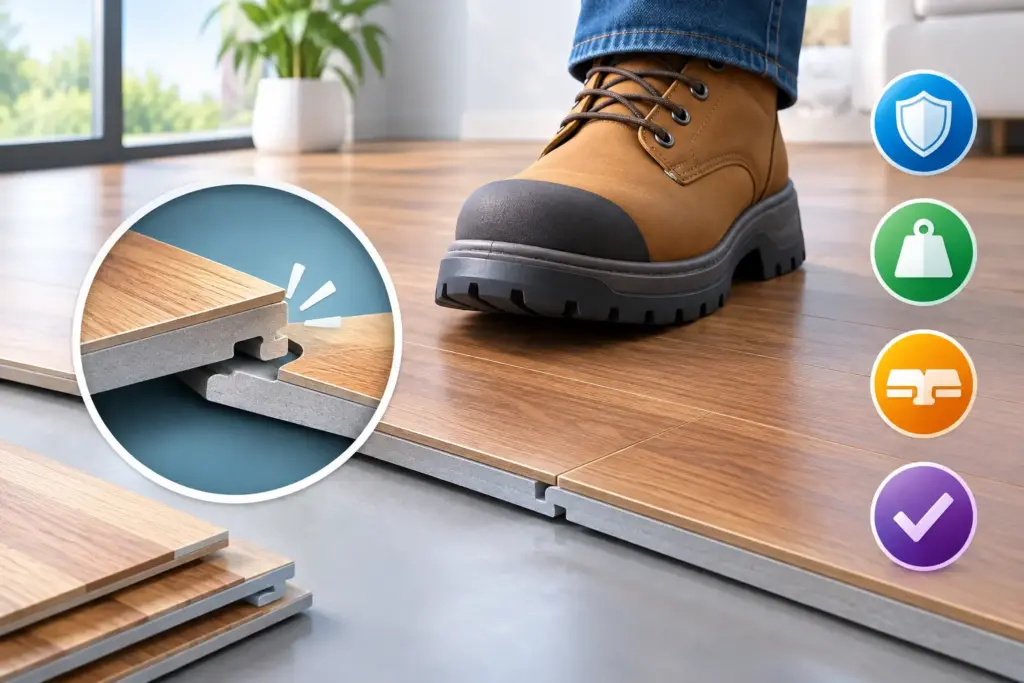
A click-flooring plank can look excellent on a sample board and still create costly problems once installation begins. Click lock testing examines the part of the floor that carries the greatest installation risk: the joint between planks. For contractors, distributors, developers, and buyers, it provides evidence that a flooring system can assemble accurately, remain engaged under use, and deliver a finished surface that looks consistent across the project.
The test results matter because the click system is not merely a convenience feature. It affects installation speed, labor confidence, joint appearance, replacement work, and the floor’s long-term stability. A plank with an imprecise or weak profile may be difficult to engage, may separate at the seams, or may sustain damage when installers need to lift and reposition a board.
What Click Lock Testing Measures
Click lock testing evaluates how a flooring profile performs when it is assembled, loaded, stressed, and handled under controlled conditions. The exact test method should reflect the product construction, locking system, intended application, and applicable market requirements. A residential renovation, a hotel corridor, and a retail project do not create the same demands.
At its core, testing answers several practical questions. Does the plank connect with a clear, controlled engagement? Does the joint resist movement after installation? Can the locking profile tolerate normal installation handling without chipping or deforming? Does the floor maintain a tight, visually clean seam when exposed to everyday traffic and environmental changes?
For SPC and luxury vinyl click flooring, performance begins with precision. The core, wear layer, backing, decorative film, plank dimensions, and milled locking profile must work together. Even a high-quality virgin-material SPC core cannot compensate for a poorly controlled click profile. Likewise, an attractive design layer does not solve a joint that requires excessive force or fails to remain secure.
Locking strength and joint retention
One key area is joint strength. Test procedures can assess resistance to forces that attempt to pull connected planks apart or shift them sideways. This helps indicate whether the lock will remain engaged when furniture is moved, traffic changes direction, or a floating floor experiences ordinary movement.
Results should be interpreted carefully. A stronger number is not automatically better if the profile becomes difficult to install or prone to edge damage. The objective is a well-engineered balance: a joint that holds firmly while still allowing trained installers to assemble the floor efficiently and correctly.
Installation resistance and profile durability
A click system should tolerate the actions required during installation. Depending on its design, that may include angling a plank into place, tapping along an edge, or engaging an end joint. Testing can reveal whether corners crack, tongues crush, or locking edges become damaged when normal installation forces are applied.
This is particularly relevant for large-format planks and projects where crews must work quickly across broad areas. A profile that feels acceptable on a few showroom samples may behave differently over hundreds of square feet. Consistent machining and batch control are essential, since small profile variation can lead to uneven engagement from carton to carton.
Repeated assembly and disassembly
Some click floors are designed to withstand limited lifting and reinstallation more effectively than others. Repeated assembly testing helps assess whether a joint retains its shape and locking ability after a plank is removed and reconnected.
The trade-off is straightforward. Not every product needs to be repeatedly dismantled, especially when it is installed as a permanent commercial floor. However, this characteristic can matter during fit-out work, repair situations, staged installation, or quality checks where installers need to correct a board without replacing it.
Why Click Lock Testing Matters on Real Projects
A flooring specification often focuses on thickness, wear layer, color, and water resistance. These are important purchasing criteria, but they do not fully describe installation performance. The click system determines how those planks become one floor.
For contractors, dependable joints reduce avoidable interruptions. When boards engage predictably, crews spend less time forcing connections, trimming damaged edges, or sorting through cartons to find planks that fit. That supports cleaner handover schedules and reduces the chance of visible gaps being discovered after the project is complete.
For distributors and retailers, click lock consistency protects confidence in the product range. A reliable sample must correspond to the material customers receive later. Batch-to-batch precision helps sales teams, installers, and end users set realistic expectations about fitting, finish quality, and performance.
For developers, hospitality teams, and commercial buyers, the value is larger than the installation day. Joint integrity influences the floor’s appearance over time. A floor with stable seams supports the polished, continuous visual effect expected in lobbies, residences, offices, and retail environments.
Testing is also relevant to claim prevention. Not every joint issue is a manufacturing issue. Uneven subfloors, missing expansion allowances, unsuitable underlayment, excessive moisture conditions, and incorrect installation methods can all affect a floating floor. Still, a documented, consistently produced locking system gives project teams a stronger starting point and makes troubleshooting more precise.
How to Evaluate Click Lock Test Information
Buyers should look beyond a simple statement that a product has been tested. Ask what was tested, under what conditions, and how the results relate to the intended use. A relevant test report should identify the product construction and locking configuration being evaluated, rather than referring broadly to a different plank format or product family.
It is also worth confirming whether samples came from regular production. Prototype material can demonstrate a concept, but ongoing production control demonstrates reliability. For larger orders, consistency in core formulation, plank thickness, profile milling, and packaging protection deserves as much attention as the initial sample approval.
When comparing products, consider these questions:
- Is the click system identified by type and construction, rather than described only as “easy installation”?
- Does the supplier explain how the product is intended to be installed and what tools or methods are appropriate?
- Are test results connected to the exact plank size, thickness, and profile under consideration?
- Can the supplier maintain the approved specification across future production batches?
- Is technical support available when a project team needs installation guidance or issue assessment?
These questions are especially valuable for importers and OEM buyers. A low initial price can become expensive when inconsistent profiles cause installation delays, higher waste, or customer complaints. Factory capability, inspection discipline, and responsive communication are part of the quality equation.
Testing should reflect the full flooring system
Click lock testing is meaningful, but it is not a substitute for evaluating the complete product. SPC flooring should also be assessed for dimensional stability, wear resistance, surface durability, fire-related requirements where applicable, acoustic performance, and suitability for the installation environment.
Water resistance requires the same level of practical thinking. SPC and vinyl click flooring are well suited to spaces where moisture is a concern, but a floating floor is not an invitation to ignore subfloor moisture conditions, edge detailing, or installation instructions. Water may not damage the plank core in the same way it affects wood-based flooring, yet moisture can still affect the site, the substrate, adjacent finishes, and the overall installation.
The best specification connects product testing with site reality. A residential bedroom may prioritize comfort, quiet underfoot, and design. A busy commercial interior may prioritize traffic performance, replacement practicality, and dependable availability. Neither approach is universally better. The right choice depends on how the floor will be used and who will install and maintain it.
Precision Production Creates Better Joint Performance
A reliable click floor begins long before cartons reach a jobsite. The locking profile is produced through controlled processing, and its accuracy must be maintained throughout production. Variations in plank thickness, core density, milling alignment, or edge condition can change the way a joint performs.
At PLUZ SPC, precision manufacturing and controlled production standards support flooring systems designed for practical installation and consistent finished results. Advanced Välinge 2G and 5G click-lock systems are selected to provide dependable engagement while supporting the refined looks required across residential and commercial interiors.
For buyers, this manufacturing discipline has a practical outcome: fewer surprises. A stable, accurately produced click profile helps installers work with confidence and helps designers protect the clean lines of their selected floor color and pattern.
Before approving a flooring range or project order, treat the click joint as a performance feature, not a small detail hidden at the edge of each plank. Ask for meaningful test information, review production consistency, and match the system to the demands of the site. A well-tested lock is one of the quiet reasons a finished floor continues to look intentional long after installation day.