

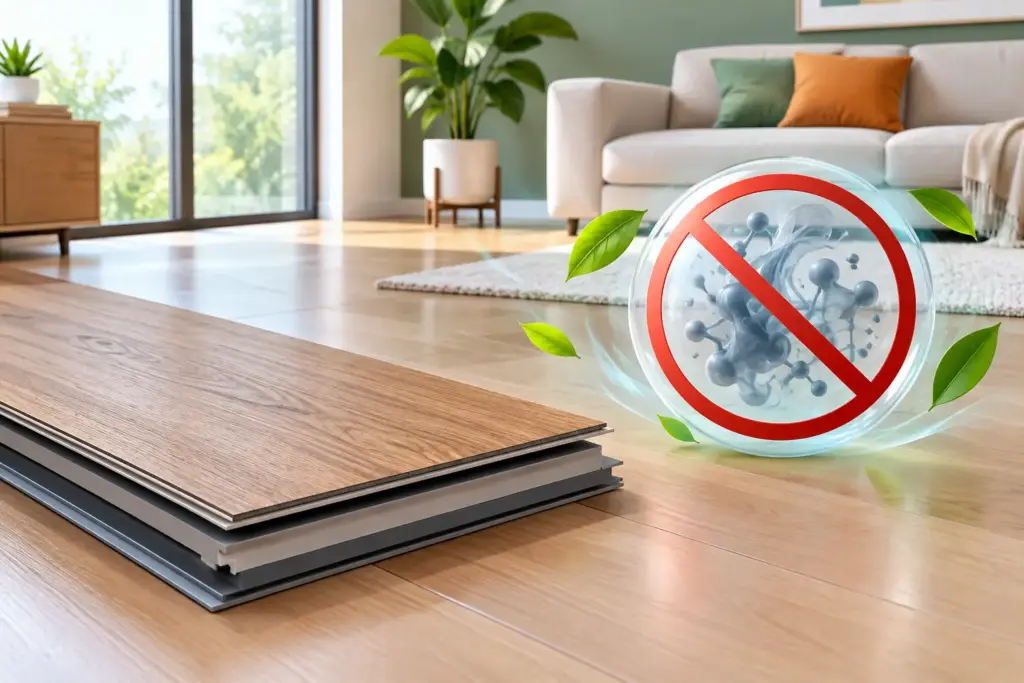
A new floor should improve a space, not leave occupants questioning the air they breathe. So, are SPC floors VOC free? The accurate answer is that quality SPC flooring can be very low in VOC emissions, but buyers should be cautious of any blanket claim that every SPC floor is completely VOC-free.
For contractors, designers, developers, and homeowners, the distinction matters. Indoor air quality is shaped by the flooring plank, its backing and wear layer, the underlayment, any adhesive, leveling compounds, trim sealants, and the way the room is ventilated after installation. A responsible purchasing decision looks at the complete flooring system rather than one marketing label.
Are SPC Floors VOC Free in Practice?
SPC stands for stone plastic composite. Its rigid core is generally made from calcium carbonate, PVC resin, stabilizers, and other controlled components. The finished plank commonly includes a printed design film, a protective wear layer, and an attached underlayment or backing, depending on the construction.
Because SPC is manufactured as a finished, sealed flooring product, it does not behave like unfinished timber, site-applied coatings, or flooring systems that require large volumes of wet adhesive. That can make click-lock SPC a practical low-emission option for residential and commercial interiors. Still, “low VOC” and “VOC-free” are not interchangeable terms.
VOC means volatile organic compounds, which are chemicals that can evaporate into indoor air. Some emissions may occur from materials used in production, packaging, adhesive-backed components, or installation products. Emissions also tend to be most relevant when materials are new. The right question is not simply whether a product contains any chemical component. It is whether the finished floor has been tested for indoor-air emissions and whether the full installation is specified responsibly.
A dependable supplier should be able to explain the product construction, identify applicable test reports or third-party certifications, and provide documents that match the specific collection and production batch being supplied.
What Determines VOC Emissions From SPC Flooring?
The quality of raw materials and manufacturing control have a direct effect on product consistency. SPC made with 100% virgin materials offers a more controlled formulation than material containing uncertain recycled inputs. Virgin PVC resin and carefully selected additives help manufacturers maintain consistent color, rigidity, click performance, and material quality from batch to batch.
That said, virgin material alone is not proof of low VOC emissions. It is one part of a controlled manufacturing process. The finished product should still be assessed through recognized emissions testing.
The Plank Construction
The core, decorative film, wear layer, and backing all contribute to the final product. A stable rigid core and well-bonded surface layers reduce the risk of material inconsistency. Buyers should also ask whether the attached pad, if included, has been evaluated as part of the product assembly. A low-emission plank paired with an unverified foam backing is not the same as a fully tested flooring system.
Manufacturing Discipline
Precision production matters beyond dimensions and click-lock fit. Controlled temperatures, clean processing, reliable material sourcing, and quality checks support consistent output. For large projects, this becomes particularly valuable. A sample that performs well is only useful if the delivered production run matches it.
For OEM buyers and distributors, request documentation for the exact product specification, not a generic factory statement. Confirm the thickness, wear layer, backing type, décor film, and intended market. Small construction changes can affect what is being tested and supplied.
Installation Materials
One major advantage of floating click flooring is that it can often be installed without adhesive across the main floor area. This removes a potential source of indoor emissions and can simplify future replacement work. Advanced click systems also help installers achieve secure plank-to-plank connections without relying on glue at the joints.
However, a glue-free floor is not necessarily an emission-free installation. Floor patching compounds, moisture barriers, transition profiles, perimeter sealants, and wall repairs can all affect indoor air quality. On commercial projects, these materials should be included in the specification review, especially where occupancy begins soon after handover.
Which Certifications Should Buyers Request?
Certifications and test reports help turn a broad air-quality claim into something measurable. Depending on the project location and requirements, buyers may look for recognized indoor-air-emission programs such as FloorScore or GREENGUARD Gold, along with relevant regional compliance documentation.
These programs are useful because they evaluate emissions against defined criteria. They are more meaningful than phrases such as “eco-friendly” or “healthy flooring” without evidence. For schools, hospitality spaces, healthcare settings, multifamily developments, and offices, project teams may also have their own required standards through architectural specifications or green-building programs.
When reviewing documents, check four details:
- The report identifies the actual product or product family being purchased.
- The document is current and issued by a credible testing or certification body.
- The construction shown in the report matches the proposed plank, including attached backing where applicable.
- The report supports the project’s specific requirement, rather than a different regulatory market or unrelated performance claim.
VOC testing should also not be confused with every other health or compliance concern. VOC emissions, phthalate content, heavy metals, formaldehyde, and fire performance are separate topics that may require separate documents. A product can meet one requirement without automatically meeting all others.
Low VOC Does Not Mean Zero Odor
A new SPC floor may have a temporary material or packaging odor when cartons are first opened. Odor is not a reliable measurement of VOC content, and the absence of odor does not prove that emissions are zero. Still, a strong or persistent smell deserves attention, particularly in a closed room or a project with sensitive occupants.
Before installation, store cartons in a dry, climate-appropriate area according to the manufacturer’s instructions. During and after installation, ventilate the room well. Remove packaging promptly, and allow time for the completed space to air out before full occupancy when the project schedule permits.
If an odor remains unusually strong after ventilation, stop treating it as a normal finishing detail. Review the flooring, underlayment, adhesives, and any other materials introduced during the work. This practical approach protects both the installer and the end user.
How to Specify Lower-Emission SPC Flooring
For a homeowner, the process can be straightforward: choose a reputable rigid-core click floor, request emissions information, avoid unnecessary adhesives, and use compatible installation materials. For a contractor or procurement team, the process should be more formal.
Start with the environmental and indoor-air requirements in the project specification. Then request product data before final approval, including the proposed construction, test reports, warranty terms, and installation instructions. Confirm that the subfloor preparation products and underlayment are compatible with the chosen flooring and suitable for the intended indoor environment.
Durability also belongs in the discussion. A floor that is water-resistant, scratch-resistant, stable under normal use, and easy to maintain can reduce the likelihood of early replacement. Longer service life supports better material value and avoids bringing another round of new products into the space sooner than necessary.
At PLUZ SPC, manufacturing control begins with virgin materials and extends through consistent production, click-lock performance, and project support. For buyers comparing suppliers, the strongest signal is not a broad promise. It is the willingness to provide clear, product-specific information and stand behind the delivered flooring.
The Practical Buying Standard
SPC flooring can be an excellent choice for projects seeking attractive, durable, low-maintenance floors with a lower-emission installation approach. It is especially well suited to renovations where a floating click system can avoid extensive adhesive use and help keep schedules moving.
But do not purchase on the words “VOC-free” alone. Ask what has been tested, what materials are included in the installation, and whether the documentation matches the exact floor you plan to install. A well-made SPC floor, paired with verified emissions data and thoughtful installation materials, gives a project team a far more reliable path to healthier indoor air and a finished space that performs as confidently as it looks.