

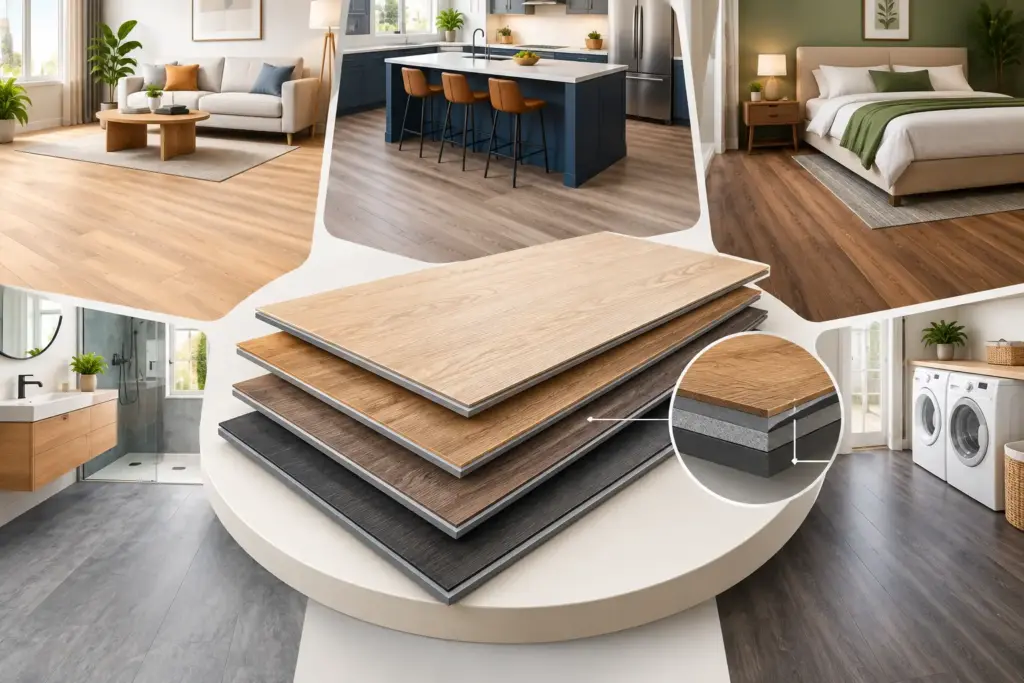
A floor can look right on a sample board and still be wrong for the project. In this vinyl plank thickness guide, the key is to separate overall plank thickness from the wear layer, core construction, and installation conditions. A thicker plank is not automatically more durable, but the right specification can improve stability, comfort, sound control, and long-term appearance.
For contractors, designers, retailers, and homeowners, thickness should be a performance decision rather than a marketing comparison. The best choice depends on traffic, subfloor condition, room transitions, furniture loads, and the type of vinyl flooring being specified.
What vinyl plank thickness actually measures
Vinyl plank thickness is usually stated in millimeters and refers to the full height of the plank, from its surface coating to the bottom backing or attached pad. Common click-flooring options range from about 3.5 mm to 8 mm or more. In SPC flooring, 4 mm, 5 mm, and 6 mm are common specifications, with an attached underlayment often adding 1 mm to 1.5 mm to the total installed height.
That number matters because it affects the rigidity of the plank, its ability to bridge minor subfloor variation, the feel underfoot, and how the floor meets adjacent finishes. It does not, by itself, tell you how well the surface will resist scratches, stains, or foot traffic. Those outcomes depend heavily on the wear layer and protective finish.
A purchasing specification should therefore identify at least four separate elements: total plank thickness, core type, wear-layer thickness, and attached underlayment. Treating them as one measurement can lead to an uneven comparison between products.
Total thickness and wear layer are different jobs
The wear layer is the clear protective vinyl layer above the printed design film. It is commonly measured in mil, not millimeters. One mil equals one-thousandth of an inch, so a 12 mil wear layer is not the same as a 12 mm plank.
For lower-traffic residential spaces, a 6 to 12 mil wear layer may be appropriate depending on household use. For active family homes, rental properties, and light commercial interiors, 12 to 20 mil offers a stronger margin against daily abrasion. Commercial spaces with frequent foot traffic, rolling luggage, reception use, or retail activity often benefit from 20 mil or a project-specific commercial specification.
The wear layer is not the only protection. The quality of the UV coating and surface treatment also affects scratch resistance and cleanability. A well-manufactured plank with a balanced wear layer and durable finish can be a better project choice than a thicker product with weak surface protection.
Vinyl plank thickness guide by application
A practical thickness range starts with how the room will be used, not with the highest number on a product label.
| Application | Typical SPC plank thickness | What to prioritize | | — | — | — | | Bedrooms and low-traffic residential rooms | 4-5 mm | Comfortable finish, stable click system, suitable wear layer | | Living rooms, kitchens, and family areas | 5-6 mm | Better rigidity, 12-20 mil wear layer, moisture resistance | | Condominiums and renovation projects | 4-6 mm | Finished floor height, acoustic requirements, easy installation | | Offices, boutiques, and hospitality rooms | 5-6.5 mm | Commercial wear layer, reliable locking strength, batch consistency | | High-traffic commercial areas | 6 mm and above, as specified | Surface durability, flat subfloor, tested project performance |
These ranges are planning references, not universal rules. A 4 mm SPC plank can perform very well on a properly prepared, flat substrate in a bedroom or apartment. A 6 mm product may be the better option in a busy office, but only if its wear layer, locking profile, and installation method are also suited to the job.
4 mm to 5 mm: efficient for controlled conditions
Thinner click planks are useful where controlling finished floor height is a priority. They can work well in residential bedrooms, apartments, and renovation projects where doors, cabinets, or existing transitions leave limited clearance.
The trade-off is that thinner rigid-core flooring has less material to help manage small imperfections below it. It still requires a flat, dry, sound subfloor. Installing any click floor over dips, ridges, loose tiles, or uneven concrete can stress the joints and create movement at the seams.
5 mm to 6 mm: a versatile project range
For many residential and light commercial projects, 5 mm to 6 mm provides a practical balance of rigidity, installation handling, and finished feel. It is substantial enough for most active rooms while remaining manageable around transitions and existing door openings.
This range is often appropriate for kitchens, living spaces, corridors, offices, and retail interiors, particularly when paired with a 12 mil to 20 mil wear layer. For project teams, it also offers a familiar specification that is easier to compare across collections and suppliers.
6 mm and above: added rigidity, not a substitute for preparation
Thicker SPC flooring can feel more solid underfoot and may offer improved resistance to minor subfloor telegraphing. It can also be beneficial where a more substantial finished floor is desired or where an attached acoustic pad is part of the specification.
However, thickness does not eliminate subfloor requirements. A rigid plank installed over significant unevenness can still flex at the joints, produce noise, or fail prematurely. The correct approach is to prepare the substrate to the flooring manufacturer’s flatness requirements, then select the plank thickness that suits the space.
Consider the core before comparing millimeters
Luxury vinyl flooring can use different constructions, including flexible LVP, WPC, and SPC. Two products with the same overall thickness may behave very differently because their cores are different.
SPC, or stone plastic composite, uses a dense rigid core designed for dimensional stability and moisture resistance. It is well suited to busy residential interiors and many commercial environments. Its density supports a precise click-lock profile and helps create a firm, stable surface when installed over a properly prepared subfloor.
WPC generally has a more cushioned feel, while flexible vinyl can be more forgiving in certain applications but may require a smoother substrate. There is no single best core for every project. For spaces that need strong click-lock performance, water resistance, and resistance to everyday movement, a quality SPC construction is often the practical choice.
Do not overlook attached underlayment
An attached underlayment can change both the stated thickness and the installed experience. IXPE and EVA pads are commonly used to reduce reflected footfall sound, add slight comfort, and simplify installation. They should not be described as making a floor silent, especially in multi-family or commercial buildings with formal acoustic requirements.
When comparing products, ask whether the listed thickness includes the pad. A 5 mm plank plus a 1 mm pad may be sold as 6 mm overall. Both measurements are useful, but they answer different questions: core thickness relates to plank rigidity, while the pad contributes to the total floor height and acoustic performance.
For condominiums, hotels, and upper-floor spaces, review the building’s sound-control requirements before ordering. Some projects require specific tested assemblies, and a thicker attached pad alone may not satisfy them.
Thickness affects transitions and installation details
Every additional millimeter changes the relationship between the new floor and adjacent tile, carpet, wood, cabinetry, appliances, and doors. This is especially relevant in renovation work, where an attractive 6 mm or 7 mm product can create avoidable door-clearance or transition issues.
Measure the full system before final selection: plank, attached pad if included, any approved underlayment, and moisture barrier where required. Confirm expansion gaps, transition profiles, and whether heavy fixed cabinetry will sit on the floating floor. These details protect the click system and produce a cleaner finished result.
A reliable locking system also matters. Precision-manufactured click profiles, including Välinge 2G and 5G systems, are designed to support efficient installation and strong plank engagement. Even so, installers should never force damaged or misaligned planks together. A clean, flat substrate and proper locking technique remain essential.
Questions to ask before approving a specification
Before placing an order, project teams should confirm the total thickness in millimeters, the wear-layer thickness in mil, the core construction, and whether an underlayment is included. They should also check the required subfloor flatness, expansion requirements, warranty conditions, and whether the product is intended for the expected traffic level.
For OEM buyers and distributors, consistency is equally important. A specification should be supported by stable production controls, clear batch identification, reliable dimensions, and repeatable color and surface quality. Thickness is valuable only when it is manufactured consistently across the order.
PLUZ SPC produces rigid click flooring with 100% virgin, recyclable materials and precision manufacturing controls, helping project partners specify flooring with confidence across residential and commercial applications.
Choose thickness as part of a complete flooring system, not as a standalone number. When the core, wear layer, subfloor preparation, and room demands are aligned, the finished floor is more likely to install cleanly, perform reliably, and keep its intended design character for years.