

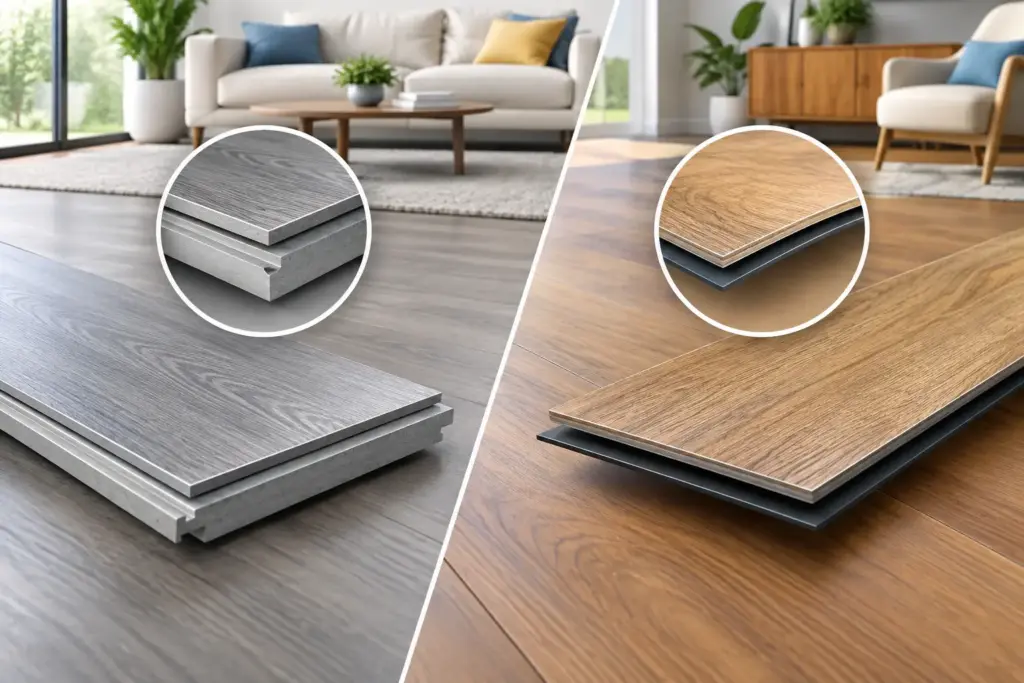
A floor can look right on a sample board and still be wrong for the site. That is the real question behind SPC versus LVT flooring: not which material wins in every setting, but which construction will perform reliably under the demands of a specific home, retail space, hotel room, or multi-unit project.
Both are popular vinyl flooring options with convincing wood and stone visuals, straightforward maintenance, and strong water resistance. Their differences sit beneath the decorative layer. Core construction affects how the floor handles subfloor variation, temperature changes, sound, foot comfort, and installation. For contractors, designers, distributors, and homeowners, understanding those differences helps prevent costly specification mistakes.
SPC Versus LVT Flooring: The Core Difference
SPC stands for stone plastic composite. It is a rigid-core vinyl flooring built with a dense core that typically combines natural limestone powder, PVC, and stabilizers. Above that core sit the printed design film and protective wear layer; beneath it may be an attached underlayment. The result is a stable click flooring plank designed for fast floating installation and high daily-use resistance.
LVT means luxury vinyl tile, a broader category that includes vinyl planks and tiles in flexible and rigid constructions. In common project discussions, LVT often refers to traditional flexible vinyl flooring that is glued directly to a prepared subfloor. Some LVT products also use click systems, so buyers should never rely on the label alone. Ask for the full construction, core type, wear layer, backing, and recommended installation method.
This distinction matters because SPC is technically part of the larger luxury vinyl family. Comparing SPC with LVT is usually a comparison between rigid-core click flooring and flexible glue-down vinyl, not between two entirely unrelated materials.
When SPC Is the Stronger Choice
SPC is often specified where a project needs stability, installation speed, and dependable performance across large areas. Its dense rigid core is more forgiving of minor subfloor texture than flexible LVT, although it does not eliminate the need for proper subfloor preparation. Serious dips, peaks, moisture issues, and structural movement must still be corrected before installation.
Moisture-prone interiors and active spaces
Because SPC planks are water-resistant, they are well suited to kitchens, entryways, living areas, offices, retail stores, and many hospitality settings. Water resistance refers to the flooring material itself, not an automatic guarantee against water entering at wall edges, expansion gaps, or failed transitions. Good perimeter detailing remains essential.
For busy interiors, the rigid construction also supports a solid underfoot feel and helps the floor maintain a clean plank profile. A quality wear layer adds protection against everyday scuffs and scratches from chairs, rolling luggage, pets, and normal commercial traffic. The right wear-layer specification should match actual use, rather than simply aiming for the highest number on paper.
Fast, clean installation
Click-lock SPC is designed to reduce installation time compared with fully adhered flooring. Advanced locking profiles, such as Välinge 2G and 5G systems, help installers create tight joints with a consistent connection. This can be especially valuable for renovation projects where downtime affects residents, retail operations, or handover schedules.
A floating floor also makes individual plank replacement more practical in certain situations. Still, installers need to follow layout, expansion-gap, and substrate requirements closely. A click system is precise engineering, not permission to rush the preparation work.
Large-format and multi-unit consistency
For developers, procurement teams, and flooring distributors, SPC can offer a practical balance of visual appeal and repeatable performance. A manufacturer with controlled production, 100% virgin materials, and consistent batch standards can help reduce variation across phases, units, and replenishment orders.
PLUZ SPC produces Malaysian-made SPC and luxury vinyl click flooring for projects that require this kind of dependable supply, with designs that range from Nordic and Minimalist to Rustic, Vintage, Contemporary, and Urban interiors.
Where Traditional LVT Has an Advantage
Flexible glue-down LVT remains a respected commercial flooring solution. It should not be treated as an outdated alternative to SPC. In the right environment, it can be the more suitable specification.
A quieter, softer walking feel
Flexible LVT generally feels softer and warmer underfoot than a rigid SPC plank. It can be a compelling choice for environments where comfort is a major consideration, including certain healthcare, education, workplace, and residential applications. Acoustics depend on the full floor assembly, but glued LVT can provide a more subdued step sound because it is bonded directly to the substrate.
SPC with an attached acoustic underlayment can also reduce impact noise effectively. The decision should be based on the tested acoustic performance of the chosen system, local building requirements, and whether sound transfer between floors is a concern.
Complex layouts and high-traffic commercial areas
Glue-down LVT is often preferred for very large open areas, spaces with heavy rolling loads, or layouts requiring intricate patterns. Because it is adhered to the subfloor, it has less potential for movement than a floating installation when specified and installed correctly. It can also make individual tile replacement straightforward when spare stock is available.
The trade-off is more demanding preparation. The subfloor must be smooth, dry, clean, and properly leveled. Adhesive selection, open time, temperature, and moisture testing all affect long-term results. These details require skilled installation and careful jobsite control.
Compare the Factors That Affect Real Performance
The best flooring decision comes from evaluating the entire installation, not only the plank price or showroom appearance.
Subfloor condition
SPC can bridge very minor texture better than flexible LVT, which may telegraph subfloor imperfections through the finished surface. Neither product can correct an uneven slab. If the substrate has significant defects, moisture vapor concerns, or structural issues, budget for remediation before comparing finish materials.
Sunlight and temperature exposure
All vinyl flooring can expand or contract when exposed to substantial temperature swings. Rooms with large unshaded windows, glass walls, or direct heat need extra attention. SPC’s rigid core offers good dimensional stability, but it still has installation limits. Confirm the manufacturer’s requirements for sun exposure, temperature range, window treatments, and expansion space.
Wear-layer quality and surface protection
Do not compare products by thickness alone. The wear layer, protective coating, embossing quality, locking precision, and core composition all influence service life. A thicker plank with weak surface protection may not outperform a well-engineered product with a suitable commercial wear layer.
For retailers and importers, request technical data and inspect sample boards under real lighting. For project teams, approve a mockup before finalizing color, texture, transitions, and installation direction.
Maintenance expectations
Both SPC and LVT are easier to maintain than many natural flooring materials. Regular sweeping or vacuuming with a hard-floor setting removes abrasive grit, while a damp mop and manufacturer-approved cleaner handle routine soil. Avoid flooding the floor, steam cleaning unless explicitly approved, and harsh solvents that can damage the protective finish.
Use entry mats and furniture pads. These simple measures reduce surface wear more effectively than frequent aggressive cleaning.
How to Specify the Right Floor
Begin with the space rather than the product name. Consider the type of traffic, expected moisture exposure, subfloor condition, acoustic requirements, installation window, design intent, and maintenance resources. A homeowner renovating a kitchen may prioritize water resistance and easy click installation. A hotel operator may prioritize replacement planning, room turnaround, noise control, and consistent supply. A retail chain may need stable color continuity across multiple locations.
Then request a clear product specification. It should identify the core type, total thickness, wear-layer thickness, locking or adhesive installation method, underlayment, fire-performance information, warranty terms, and recommended use. For commercial work, confirm that the product is appropriate for the expected traffic level and local code requirements.
For overseas OEM buyers and distributors, manufacturing transparency matters just as much as the specification sheet. Review quality controls, raw-material standards, production capacity, packaging, batch traceability, and communication practices. A factory visit or production-line review can reveal the discipline behind the finished plank.
Choose for the Conditions, Not the Trend
SPC is a strong choice when a project benefits from a rigid, water-resistant click floor with efficient installation and stable everyday performance. Traditional glue-down LVT may be the better answer when a softer feel, precise pattern work, or a fully adhered system for demanding commercial conditions takes priority.
The most dependable floor is the one matched to the building, the substrate, and the people who will use it every day. Start with those realities, verify the technical details, and let the finished space guide the final choice.