

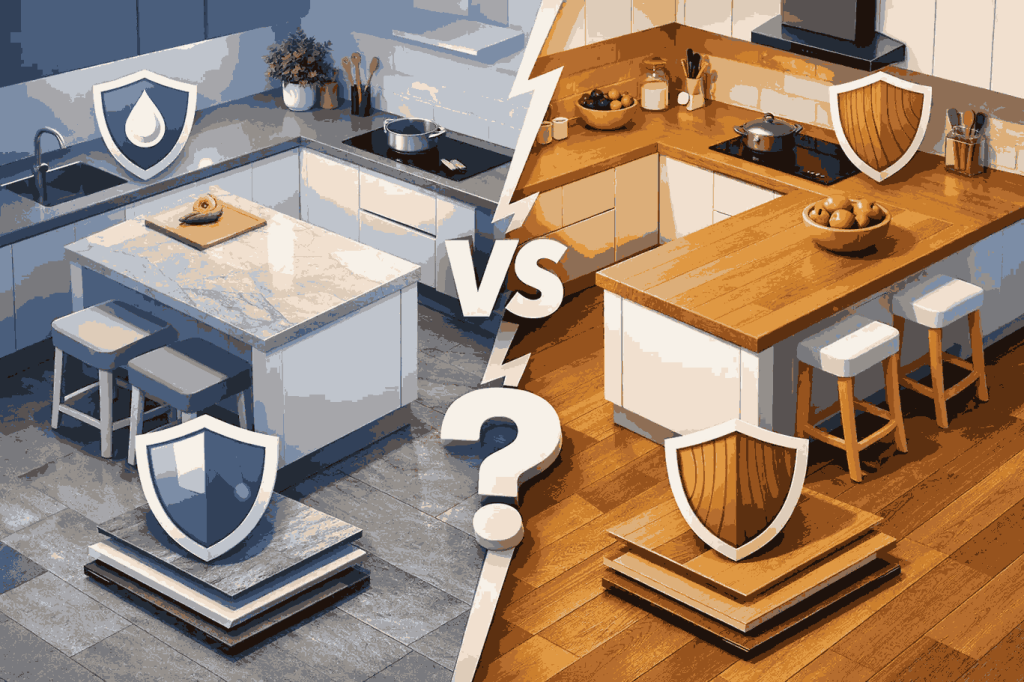
A kitchen floor is tested in small, repeated ways: a wet dish towel dropped by the sink, a refrigerator delivery, chair legs pushed back at breakfast, and the occasional overflowing pet bowl. That is why SPC vs laminate for kitchens is not simply a style decision. The core question is whether the floor can maintain its appearance and structural stability when moisture, traffic, and daily cleanup are part of the job.
Both options can create a convincing wood-look floor at a practical price point. Both are floating click-floor systems that can reduce installation time compared with many traditional materials. Yet their cores respond very differently to water, impact, temperature changes, and long-term wear. For a residential renovation, a multifamily development, or a commercial hospitality project, those differences should guide the specification.
SPC vs Laminate for Kitchens: The Core Difference
SPC stands for stone plastic composite. Its rigid core is typically made from a blend of natural limestone powder, polyvinyl chloride, and stabilizers. This construction creates a dense, dimensionally stable plank that is designed to resist water exposure. A decorative film gives the plank its wood or stone appearance, while a protective wear layer helps defend against scuffs and scratches.
Laminate flooring uses a high-density fiberboard core. It also has a decorative layer and protective top surface, but its core is wood-based. That distinction matters in kitchens. When water reaches an unprotected laminate edge, seam, or damaged surface, the fiberboard can absorb moisture and swell. Once swelling occurs, the board generally cannot be restored to its original profile.
Some modern laminate products offer improved water resistance through sealed edges, tighter locking systems, and surface treatments. These products can perform well when spills are cleaned promptly. However, water-resistant is not the same as waterproof, and a kitchen creates more opportunities for prolonged moisture at joints and perimeter areas.
Water Resistance Is Usually the Deciding Factor
For most kitchens, SPC has the stronger practical advantage because its core does not absorb water in the way a fiberboard core does. A spill left beneath a mat, condensation from an appliance, or wet shoes near an exterior door is less likely to compromise the plank itself. This makes SPC a sound choice for busy family kitchens, rental properties, and projects where maintenance habits can vary from user to user.
That does not mean an SPC floor is immune to every water-related issue. Water can still travel beneath a floating floor through expansion gaps, damaged joints, or poor detailing around cabinets and appliances. Subfloor moisture must also be evaluated before installation. Waterproof planks protect the flooring material, but they do not solve an active leak, an uneven substrate, or a failed moisture barrier.
Laminate can still be appropriate in a lower-risk kitchen with careful occupants, limited spill exposure, and a product specifically rated for kitchen use. It is a better fit when the priority is a particular laminate visual or surface texture and the owner accepts the need for fast spill cleanup. For a project team seeking a wider margin of performance, SPC is generally easier to specify with confidence.
Durability Depends on More Than the Wear Layer
Both flooring types are available in different quality levels. A low-grade SPC plank and a premium laminate plank should not be treated as direct equivalents. The wear layer, surface coating, core density, locking profile, backing, and manufacturing consistency all affect how the floor performs.
SPC is known for its rigid, impact-resistant construction. It can handle rolling loads, dropped utensils, and everyday kitchen movement well, especially when paired with a properly prepared subfloor. Its dense core also contributes to stability in environments with changing temperatures. For contractors and property managers, this can mean fewer concerns about localized damage caused by normal use.
Laminate often has a harder surface feel and can deliver strong scratch resistance, particularly in products with high abrasion ratings. It may be a good choice in dry, active areas where sharp debris and pet claws are the main concern. In a kitchen, though, durability must include what happens after a scratch, chip, or worn edge allows moisture toward the core. That is where laminate has a narrower tolerance.
For either product, do not rely only on marketing terms such as scratch-resistant. Ask for clear product specifications, wear-layer details for SPC, surface durability ratings for laminate, warranty conditions, and recommended cleaning practices. Consistent production quality is especially important when a project requires multiple batches, phased delivery, or matching replacement material later.
Appearance and Comfort: Where Laminate Can Compete
Laminate remains popular for a reason. It can offer highly detailed wood patterns and embossed textures that feel close to natural timber. Some homeowners prefer its firm, dry feel underfoot, particularly when it is installed in connected living areas where the kitchen is not exposed to frequent water.
SPC has advanced significantly in visual realism. Current designs can provide refined oak, walnut, concrete, and stone-inspired looks suited to minimalist, contemporary, rustic, or urban interiors. Wide planks, synchronized textures, and carefully controlled color variation allow SPC to support a premium kitchen design without the upkeep concerns of natural wood.
Comfort comes down to the total floor system. SPC is dense, so it can feel firmer than some laminate options. An attached underlayment can improve sound absorption and walking comfort, but it should be selected according to the manufacturer’s requirements. In a kitchen, anti-fatigue mats near the sink or cooktop can make a meaningful difference regardless of the flooring selected.
Installation and Subfloor Preparation
Both SPC and laminate are typically installed as floating click floors. This can support efficient renovation schedules because the planks do not usually require full-spread adhesive. Quality click-lock systems are valuable here: they help create tight, reliable connections and allow installers to work efficiently across large areas.
SPC’s rigid structure can better mask minor subfloor imperfections than flexible vinyl, but it is not a substitute for preparation. High spots, depressions, loose substrates, and moisture issues can stress the locking system and telegraph through the finished floor. Laminate also requires a flat, dry substrate and proper underlayment. Skipping this step to save time is a false economy.
Kitchen installations need careful planning at dishwashers, refrigerator alcoves, islands, exterior doors, and transitions to adjacent rooms. Floating floors need expansion space, so fixed cabinetry should not trap the planks unless the product’s installation instructions explicitly allow that detail. Installers should also determine whether appliances should sit on the finished floor or be installed within designated openings. The correct approach depends on product instructions, appliance clearance, and site conditions.
Cost: Compare the Installed Risk, Not Only the Box Price
Laminate can have a lower material price in many product ranges, although premium water-resistant laminates may overlap with entry and mid-tier SPC. If the kitchen is dry, lightly used, and carefully maintained, laminate can offer good visual value.
But the lowest purchase price is not always the lowest project cost. Replacing swollen laminate planks after a leak or recurring water exposure can involve removing trim, disconnecting appliances, and sourcing a matching batch. In rental, hospitality, and high-use residential settings, those downstream costs can outweigh the initial savings.
SPC may carry a higher upfront cost depending on design, thickness, wear layer, and attached backing. Its value is usually found in reduced water-related risk, stable performance, easy maintenance, and suitability across connected kitchen, dining, and living spaces. For trade buyers, reliable batch consistency and dependable lead times also matter as much as the unit price.
When Each Floor Makes Sense
Choose SPC when the kitchen sees frequent cooking, children, pets, exterior-door traffic, or occasional appliance-related moisture. It is also the more practical choice for rental properties, developments, and commercial projects where the flooring must perform consistently across many users. A product made with virgin materials, a proven click system, and documented quality controls gives the specification additional assurance.
Choose laminate when moisture exposure is genuinely limited, the project requires a particular laminate texture or look, and the owner is prepared to clean spills quickly. It can be an effective flooring solution in an open-plan home where continuity with dry living spaces is the leading design priority.
For kitchens, the strongest decision is rarely about declaring one material universally better. It is about specifying the floor that matches the site, the users, and the consequences of a mistake. If water resilience, predictable maintenance, and long-term project reliability are high on the list, SPC gives the kitchen more room to handle real life without losing its finish.